1 November 2025
Why Regular Split AC Maintenance Pays for Itself Three Times Over
Most split AC owners in Kerala service their units when something goes wrong. By then, a ₹500 problem has become a ₹15,000 repair. Here's the real cost of skipping maintenance: and what a proper service actually involves.
The split air conditioner is the most common appliance in a Kerala home or office, and it is also one of the most neglected. Installed, run continuously through summer, and largely ignored until it stops cooling: this is the standard lifecycle for the majority of split AC units across the state.
The consequences of this approach play out in three ways: higher electricity bills, premature equipment failure, and repair costs that dwarf what preventive maintenance would have cost.
What happens inside a neglected split AC
The filter
Every split AC has an air filter: a mesh screen that catches dust, hair, and airborne particles before they reach the evaporator coil. In Kerala's conditions (high humidity, coastal dust, and urban particulate load), this filter needs cleaning approximately every 3–4 weeks for residential use, and every 2–3 weeks in commercial environments.
When the filter is blocked:
- Airflow across the evaporator coil drops
- The coil gets colder (restricted airflow means less heat is absorbed)
- Moisture freezes on the coil (ice formation)
- The unit works harder to push air through the restriction
- Compressor load increases, electricity consumption rises 10–15%
In severe cases, ice formation on the evaporator blocks airflow entirely. The unit blows warm air. The owner calls a technician. The technician cleans the filter (a 10-minute job) and charges a service call fee. This scenario plays out thousands of times per month across Kerala: entirely avoidably.
The evaporator coil
The evaporator coil (the indoor unit's heat exchanger) accumulates a layer of biological matter over time even with a clean filter. Microscopic mould, bacterial film, and dust bond to the cold, damp coil surface. This layer:
- Reduces heat transfer efficiency (the coil can't absorb as much heat from room air)
- Is the primary source of the musty smell that many users attribute to the unit "needing gas"
- Creates a surface for mould growth that recirculates into the room air during operation
A chemical coil cleaning: applying a biodegradable coil cleaner, letting it dwell, and rinsing: removes this biological film and restores heat transfer efficiency. This is not a DIY job because the cleaner and rinse water must be directed to the drain pan and out through the drain line, not into the room or the electrical components.
The drain line
Condensate: the moisture removed from room air: drains away through a pipe that runs from the indoor unit through the wall. In Kerala's high-humidity environment, this drain line accumulates algae, fungus, and mineral deposits that gradually restrict flow.
A partially blocked drain causes the drain pan to fill slowly. A fully blocked drain causes the pan to overflow. Overflowing into a wall-mounted unit typically means water drips down the wall, into the ceiling (if below another floor), or into the electrical wiring. The resulting water damage and short circuits are significantly more expensive to repair than a drain line that was cleared quarterly.
The condenser coil and outdoor unit
The outdoor unit's condenser coil rejects heat from the refrigerant into the outside air. It is exposed to:
- Road dust and construction particulates
- Cottonwood fluff and biological debris
- Salt air in coastal locations (accelerates corrosion)
- Insects building nests in the unit body
A fouled condenser coil increases condensing pressure: the pressure at which the refrigerant gives up heat. Higher condensing pressure means the compressor works harder, runs hotter, and uses more electricity. Over time, sustained high condensing pressure degrades compressor internals.
Cleaning the condenser coil with compressed air or a low-pressure water wash: done carefully to avoid bending the delicate fins: restores system efficiency. This is typically a 15-minute job done as part of an annual service.
Refrigerant charge
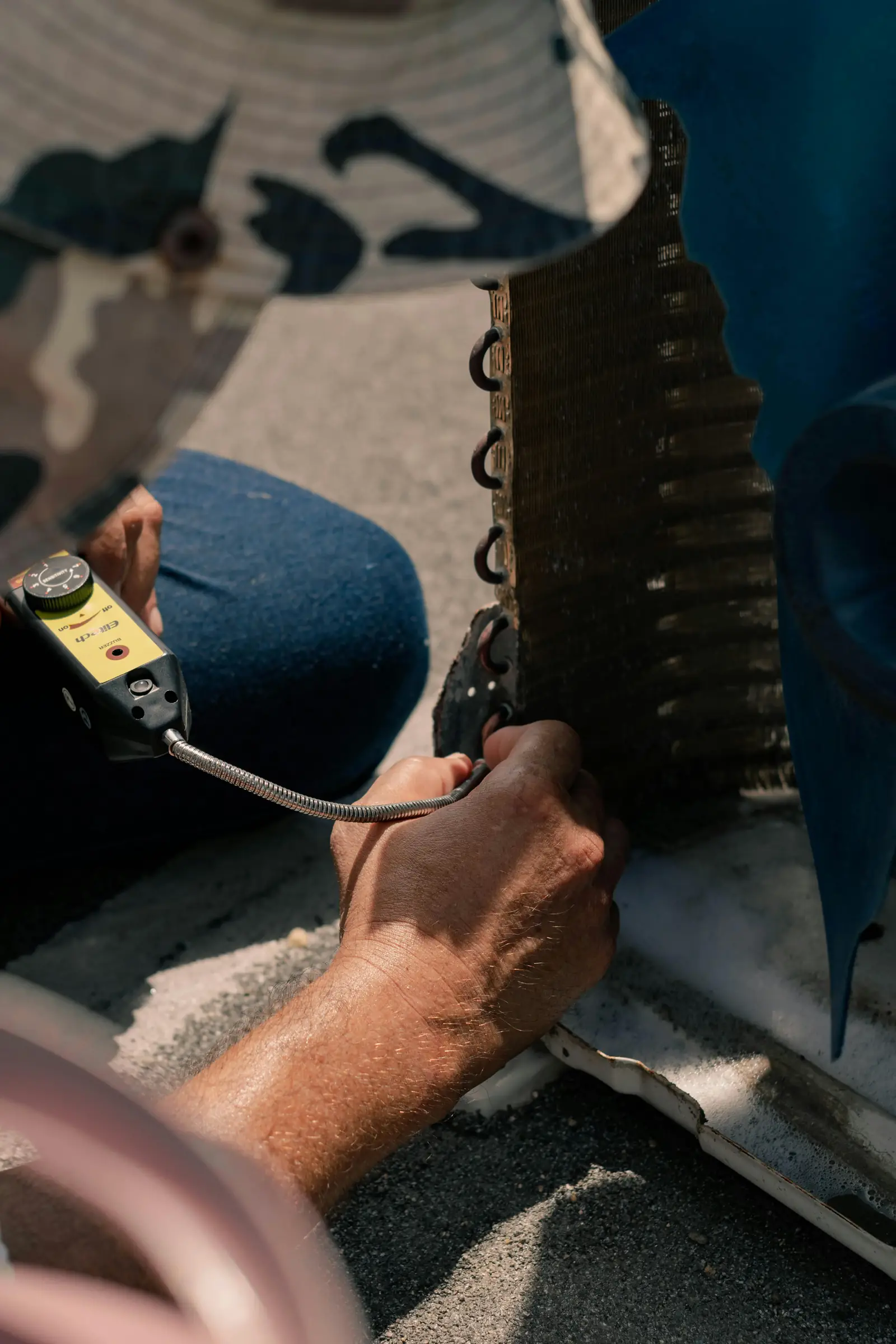
Refrigerant does not "run out" in a healthy system. It circulates continuously in a closed loop. If refrigerant level is low, there is a leak: typically at a flare fitting, valve packing, or a corroded line joint.
Low refrigerant causes:
- Reduced cooling capacity (the system can transfer less heat)
- Suction pressure drops, causing the evaporator to get too cold and ice over
- Compressor runs with insufficient suction pressure, leading to slugging and internal damage
- In severe cases, compressor failure
A refrigerant top-up without finding and fixing the leak is a temporary measure. The gas will continue to leak. The correct response is leak detection, repair, and then recharge to the manufacturer's specified level.
What a proper service actually involves
A legitimate preventive maintenance service for a split AC should include:
- Filter cleaning: remove, wash, dry, and reinstall
- Indoor coil chemical wash: apply coil cleaner, let dwell, rinse carefully
- Drain pan cleaning: remove biological growth, clear the drain outlet
- Drain line flush: clear blockages, verify free flow
- Outdoor unit inspection: clean condenser coil, check for fin damage, clear debris from unit body
- Electrical inspection: check capacitor, contactor, wiring connections
- Refrigerant pressure check: verify operating pressures against manufacturer spec
- Performance verification: measure supply air temperature, verify temperature differential across the coil
A service that does not include items 3, 4, 6, and 7 is a partial service, regardless of what it is called.
The electricity cost of neglect
Kerala's electricity tariff for residential consumers with higher consumption brackets is approximately ₹6.40–9.60/kWh. A 1.5-tonne split AC draws approximately 1.2–1.5kW in normal operation.
A unit running 10% above its rated consumption due to a dirty filter and fouled coil uses an additional 0.12–0.15kWh per hour. Over 8 hours of daily operation for 6 months, that is approximately:
0.14kWh × 8h × 180 days × ₹7/kWh = ₹1,411 in excess electricity cost
A standard AMC service for a single split AC unit in Kerala costs ₹1,500–2,500/year including two service visits. The electricity savings alone often cover the AMC cost.
When to call, not when to wait
The instinct to wait until something is visibly wrong is expensive with HVAC equipment. By the time a compressor sounds rough, the damage is done. By the time water is dripping from the indoor unit, the drain pan has been overflowing for days. By the time the unit blows warm air, the coil is iced and the refrigerant charge may be significantly low.
The correct maintenance schedule for Kerala's climate:
- Filter cleaning: every 3–4 weeks (owner-done or technician)
- Full service (chemical wash, coil clean, drain flush): every 6 months
- Comprehensive check (includes refrigerant, electrical, outdoor unit): annually
Units in coastal areas, dusty environments (near construction), or high-occupancy spaces should be serviced more frequently.
Why This Matters To HRS
Where HRS fits after the first breakdown is avoided
Routine maintenance matters most before the first serious breakdown. HRS uses AMC planning, filter and coil servicing, and proper fault diagnosis to keep comfort systems from slipping into high-power, low-performance operation.
Related Service
Annual Maintenance Contracts (AMC)Need expert HVAC help?
Contact our team for professional installation, maintenance, or a custom consultation.