23 August 2025
Residential vs Commercial HVAC: What's Actually Different and Why It Matters
A split AC and a commercial VRF system both cool rooms - but they are engineered for entirely different demands. Understanding the differences helps you choose the right system and the right service partner.
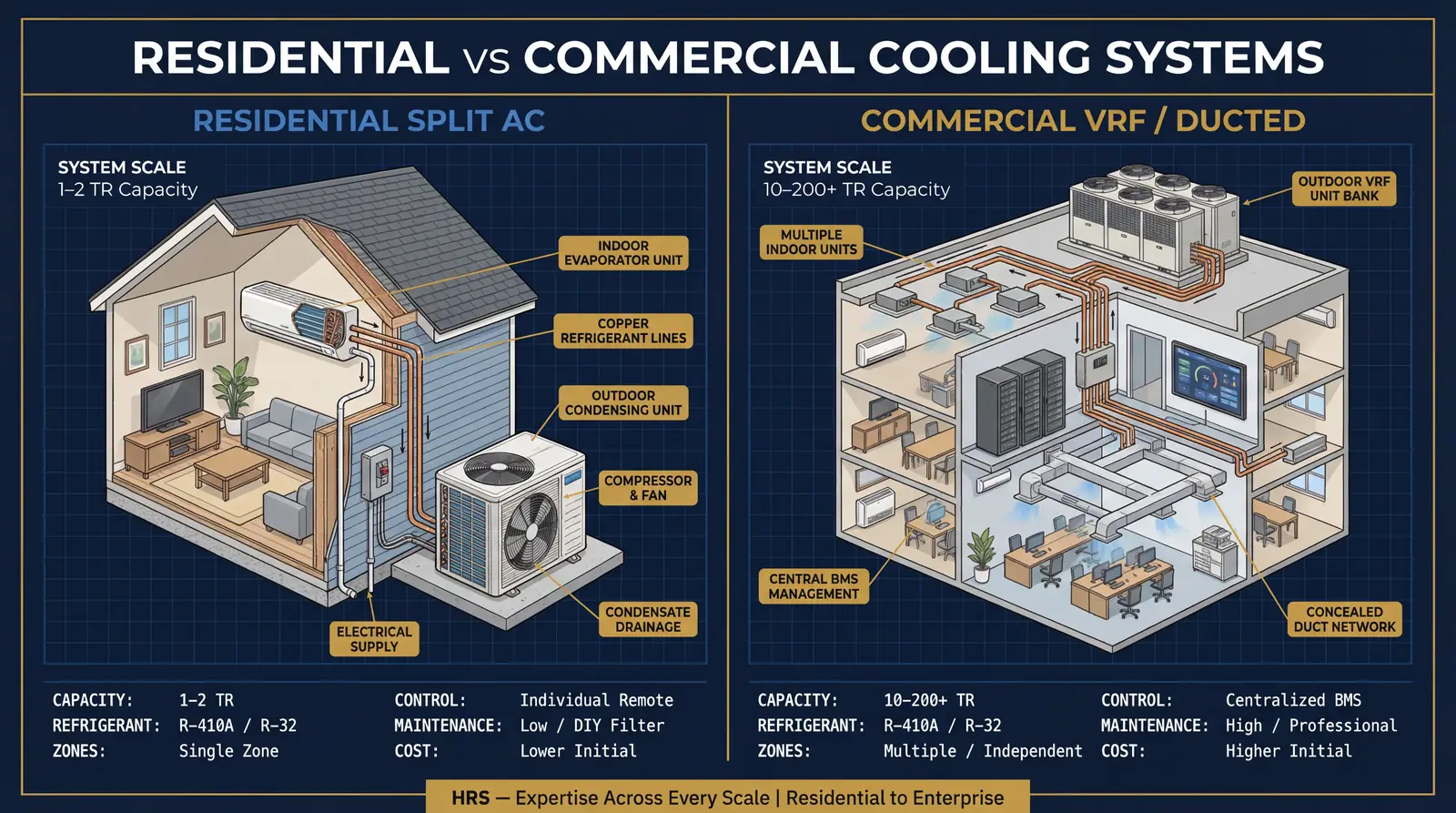
The phrase "air conditioning" covers an enormous range of technology. A 1.5-ton split AC installed in a bedroom and a 50-ton VRF system serving a bank's head office both cool air - but they share almost nothing else in common. Getting this distinction wrong is one of the most expensive mistakes in building services.
System Scale: The First Difference
Residential split AC: 1–2 tonnes of cooling capacity. One outdoor unit, one indoor unit. Cools a single room or zone.
Commercial VRF/ducted systems: 10 to 200+ tonnes of cooling capacity. Multiple outdoor units (or a chiller plant), dozens of indoor units, centrally controlled. Serves entire buildings with independent zone control.
This scale difference drives everything else - equipment specification, installation complexity, service requirements, and cost.
The Engineering Differences That Matter
Refrigerant Circuits
A split AC has one refrigerant circuit: one compressor, one condenser, one expansion device, one evaporator. When something goes wrong, one unit is affected.
A VRF system has a shared refrigerant circuit serving multiple indoor units simultaneously. The outdoor unit modulates capacity using inverter compressors and electronic expansion valves to deliver exactly the cooling each indoor unit requests at any moment. This is mechanically elegant and energy-efficient - but it requires trained engineers to diagnose and service correctly.
Controls and BMS Integration
Residential: individual remote control per unit. Temperature, fan speed, timer.
Commercial: centrally managed through a Building Management System (BMS). Every indoor unit is addressable, its set-point manageable from a central console, its energy consumption logged, its fault state alerted in real time. Commercial HVAC is infrastructure - it is managed, not just operated.
Refrigerants
Both residential and commercial systems in India are transitioning from R-410A to R-32 (for smaller systems) and newer low-GWP refrigerants. Commercial systems additionally see R-32 variants and, in larger applications, water-cooled chiller systems using refrigerants like R-134a.
The distinction matters for service: refrigerant handling for commercial systems requires certified technicians with the correct recovery and recharge equipment, not just a cylinder and a gauge set.
Maintenance Requirements
| Aspect | Residential Split | Commercial VRF/Ducted |
|---|---|---|
| Filter cleaning | Every 2–4 weeks (DIY) | Monthly, by technician |
| Coil cleaning | Annually | Quarterly to bi-annually |
| Refrigerant check | Annually | Quarterly |
| Electrical inspection | Annually | Quarterly |
| BMS calibration | N/A | Semi-annually |
| Typical AMC cost | Low | Moderate–High |
Residential units can tolerate DIY filter cleaning and annual service. Commercial systems need structured, documented AMC programmes - because a failed commercial system affects tens or hundreds of occupants, not one bedroom.
Why You Cannot Use a Residential Service Provider for Commercial Systems
This is not about brand or training. It is about fundamentals:
Diagnostic tools: Commercial VRF diagnosis requires brand-specific tools (Daikin's WAGO, Mitsubishi's CMS, Carrier's E-Link) that residential technicians do not carry or know how to use.
Refrigerant handling: Commercial systems hold significantly more refrigerant. Improper recovery during service is both illegal (under India's regulations) and expensive.
BMS integration: Fault codes on commercial systems are communicated through the BMS network, not simple LED indicators. Reading them requires proprietary software access.
Warranty protection: Manufacturer warranties on commercial systems are void if serviced by unauthorised technicians.
Liability: A failed commercial system - in a hospital, bank, or food storage facility - carries legal and contractual consequences. Only an authorised, documented service provider gives you cover.
Kerala-Specific Considerations
Kerala's climate creates specific demands for both system types:
Humidity: At 70–90% ambient relative humidity, HVAC systems must manage latent heat (dehumidification) alongside sensible cooling. Undersized systems, or systems with blocked drainage, will struggle to maintain comfort despite running continuously.
Salt air (coastal locations): Kochi, Kozhikode, Thiruvananthapuram, Kannur - coastal locations accelerate corrosion on condenser coils and electrical connections. Coastal installations need more frequent coil washing and anti-corrosion coil treatments.
Power quality: Kerala's power supply, while improving, still experiences voltage fluctuations that stress compressors. Inverter-driven systems handle this better than fixed-speed. For critical commercial applications, voltage stabilisers are recommended.
Monsoon drainage: Condensate drainage must be designed for Kerala's monsoon - drain lines that cope with high ambient humidity year-round without blockage or backflow.
Choosing the Right System
For most homes and small offices (under 5 rooms or 1,500 sq ft): split AC systems from Daikin, Carrier, LG, or Mitsubishi will serve well. Focus on inverter models, correct tonnage sizing, and a structured annual service plan.
For commercial premises (banks, hospitals, hotels, retail, IT offices): engage an authorised commercial HVAC contractor from the design stage. System selection, pipe routing, electrical supply, and BMS integration all need engineering input before equipment is purchased.
HRS handles both - residential and commercial - with dedicated teams for each. Our residential service team covers all major brands. Our commercial projects team handles Daikin VRV, Carrier, and ducted systems from design through installation and ongoing AMC.
For a system assessment or AMC proposal for your facility, contact customercare@hitechrefrigeration.services.
Why This Matters To HRS
How HRS handles the commercial side of this topic
For offices, banks, hospitals, and similar sites, HRS works as a commercial HVAC contractor rather than a retail AC reseller. The real value is in matching system type, air distribution, serviceability, and operating expectations to the business environment.
Related Service
Commercial & Corporate HVAC SystemsNeed expert HVAC help?
Contact our team for professional installation, maintenance, or a custom consultation.