8 November 2025
The Parts Inside Your Home AC: and Why Each One Matters
Understanding what's inside your split AC helps you ask the right questions when it fails, avoid being overcharged, and make smarter decisions about repair vs replacement.
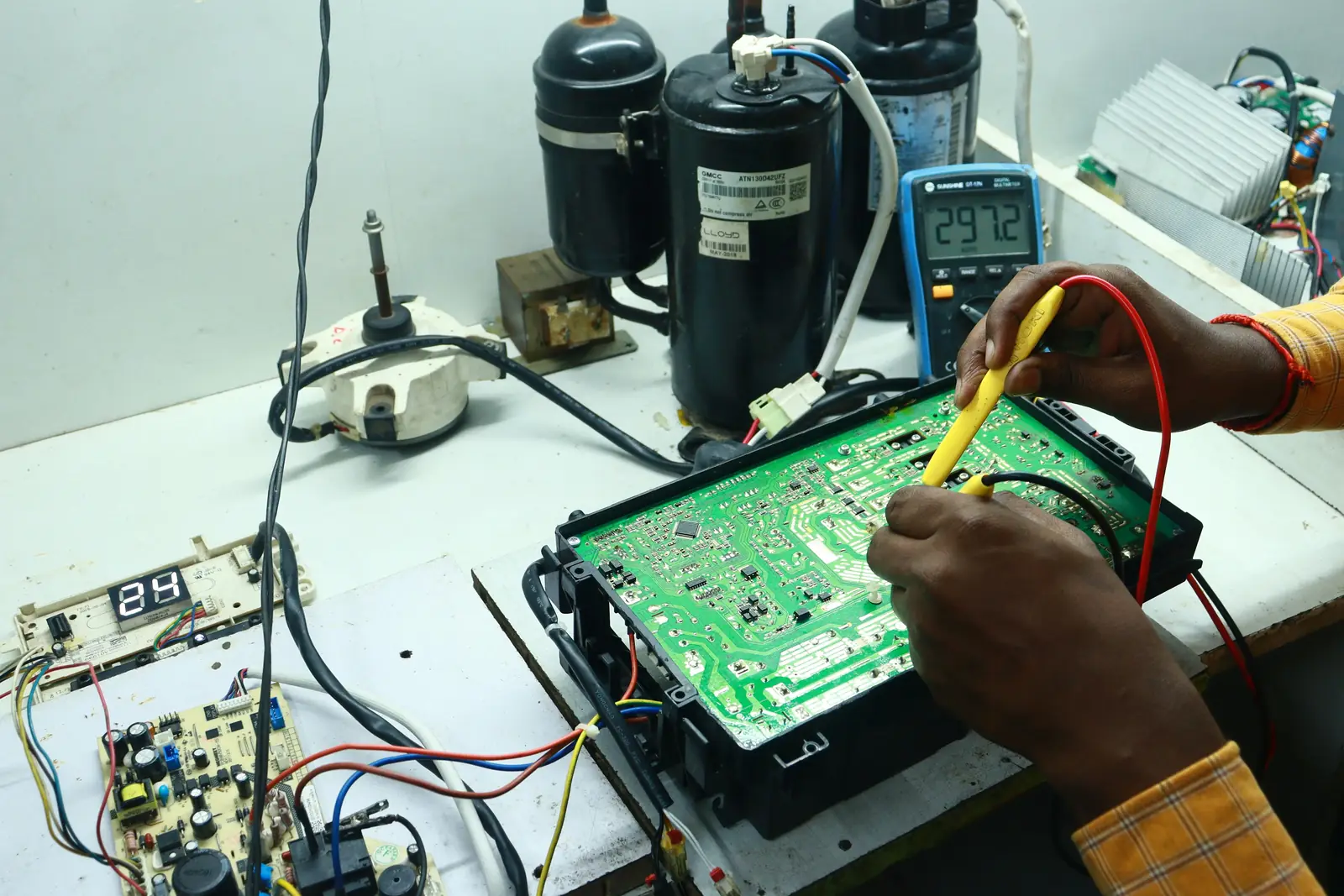
Most people treat their air conditioner as a black box: cold air comes out, you set the temperature, it runs. This works fine until something goes wrong: at which point the lack of understanding makes you vulnerable to unnecessary repairs, overcharging, and poor decisions about whether to repair or replace.
This is a plain-language guide to the key components of a residential split AC system, what each one does, how it fails, and roughly what it costs to fix or replace.
The two units and how they connect
A split AC has two main units:
Indoor unit (evaporator / air handling unit): Mounted high on an indoor wall. This is where room air is cooled and dehumidified. It contains the evaporator coil, blower fan, air filter, drain pan, and electronic control board.
Outdoor unit (condenser unit): Installed outside, usually on a wall bracket or on the ground. This is where the heat absorbed from your room is rejected into the outside air. It contains the compressor, condenser coil, condenser fan, and refrigerant service valves.
Connecting refrigerant lines: Copper tubes (typically 1/4" and 3/8" or 1/4" and 1/2" depending on capacity) carry refrigerant between the two units. These are insulated with rubber foam to prevent condensation and heat gain.
Electrical cables: Power and signal cables run between indoor and outdoor units.
Inside the indoor unit
Air filter
What it does: Catches dust, hair, and airborne particles before air passes over the evaporator coil.
How it fails: Clogs with accumulated dust, restricting airflow. This is not a failure: it is a maintenance item. Clean every 3–4 weeks.
Cost: Zero. Owner-maintained by washing and drying.
Evaporator coil
What it does: The evaporator coil is a heat exchanger: a dense array of aluminium fins bonded to copper tubes. Cold refrigerant flows through the copper tubes. Warm room air passes over the fins. Heat transfers from the air to the refrigerant, cooling the air. Moisture in the air condenses on the cold coil surface and drips into the drain pan below.
How it fails:
- Biological fouling: mould and bacterial film reduce heat transfer efficiency and cause odours
- Physical damage: bent fins from impact or improper cleaning reduce airflow
- Corrosion: in coastal Kerala, salt in the air (and in some cases, formaldehyde from new furniture) can corrode the aluminium fins and eventually the copper tubes, causing refrigerant leaks
Cost to service: Chemical wash ₹800–1,500. Full coil replacement (rare, usually for severe corrosion): ₹4,000–10,000+ depending on unit.
Blower fan (indoor fan motor)
What it does: The blower fan: a cylindrical, squirrel-cage fan: pulls room air in through the filter and over the evaporator coil, then pushes the cooled air out through the discharge vanes.
How it fails:
- Bearing wear causes a squealing or grinding noise
- Capacitor failure (shared or dedicated) prevents the motor from starting
- Accumulated dust on the fan blades (from running without a clean filter) causes imbalance and vibration
- Motor winding failure (usually from prolonged voltage issues or moisture ingress)
Cost: Fan cleaning: part of a normal service. Motor replacement: ₹800–2,500 for the motor; ₹500–1,000 labour. Bearing replacement (if serviceable): ₹300–600 parts and labour.
Drain pan and drain line
What it does: The drain pan collects condensate (water) that drips off the evaporator coil. The drain line (a small PVC pipe) carries this water out of the room, typically exiting through the wall near the outdoor unit connection.
How it fails:
- Biological growth (algae, mould) blocks the drain line
- Improper installation (insufficient slope) allows standing water to accumulate
- The drain pan itself can crack over years of thermal cycling
How you notice it: Water dripping from the indoor unit, usually from the bottom edge or the sides. Often misattributed to "the gas is leaking": gas leaks are colourless and invisible, not liquid water.
Cost: Drain line clearing: ₹300–600. Drain pan replacement: ₹800–2,000.
Control PCB (Printed Circuit Board)
What it does: The brain of the indoor unit. Receives signals from the remote control, drives the compressor (via outdoor unit communication), controls fan speed, manages defrost cycles, monitors fault conditions, and displays error codes.
How it fails:
- Voltage spikes during power restoration after outages (very common in Kerala)
- Lightning-induced surges
- Moisture or insect damage
- Component ageing (electrolytic capacitors on the board dry out after 7–10 years)
Cost: Board repair: ₹1,500–4,000 if repairable. Board replacement: ₹4,000–15,000 depending on brand and model. Prevention: a good voltage stabiliser or online UPS significantly extends PCB life.
Inside the outdoor unit
Compressor
What it does: The compressor is the most critical and expensive component. It compresses low-pressure refrigerant vapour from the evaporator into high-pressure, high-temperature vapour, which then flows to the condenser. Without a working compressor, there is no refrigeration cycle.
Modern residential split ACs use either:
- Fixed-speed (non-inverter) rotary compressors: Run at full speed when on, cycle on/off to regulate temperature
- Inverter compressors: Variable-speed motors that modulate speed to match the cooling load: more efficient, gentler on the compressor
How it fails:
- Valve wear or failure (allows gas to bypass, reducing efficiency)
- Bearing failure (causes knock or rattle, then seizure)
- Winding failure (electrical fault: compressor hums but doesn't run)
- Liquid slugging damage: if liquid refrigerant or oil reaches the compressor inlet (due to low refrigerant charge), the incompressible liquid can physically damage internal components
Cost: Compressor replacement is the most expensive single repair. Parts: ₹8,000–30,000 depending on capacity (1-tonne vs 2-tonne) and type (rotary vs scroll, non-inverter vs inverter). Labour: ₹2,000–4,500 including nitrogen flush, vacuum, and recharge. Total: frequently 50–70% of a new unit's cost for out-of-warranty units over 7 years old.
Condenser coil
What it does: The condenser coil rejects heat from the hot, high-pressure refrigerant vapour into the outside air. Refrigerant enters as hot vapour and exits as a warm liquid, ready to expand back into the evaporator.
How it fails:
- Fouling with dust, cottonwood, insects, and biological matter reduces heat transfer: the most common cause of reduced cooling efficiency in outdoor units
- Corrosion (particularly in coastal Kerala): salt deposits on aluminium fins lead to pitting and eventual tube corrosion
- Physical fin damage from impacts
Cost: Coil cleaning: part of annual service, ₹600–1,200. Coil replacement (for severe corrosion): ₹5,000–15,000.
Condenser fan motor
What it does: Forces outside air over the condenser coil to facilitate heat rejection. Without adequate airflow, the condenser cannot reject heat and condensing pressure rises to unsafe levels.
How it fails: Same failure modes as the indoor fan motor: bearing wear, capacitor failure, winding failure.
Cost: Motor: ₹1,200–3,000. Labour: ₹500–1,000.
Start/Run capacitor
What it does: Provides the phase-shifted electrical current needed to start and run both the compressor and condenser fan motor. A single capacitor often handles both (dual capacitor) or they may be separate.
How it fails: Capacitors degrade over time: the dielectric inside dries out, reducing capacitance. At a certain point, the motor cannot start. In Kerala's conditions, capacitor life is shortened by heat (the outdoor unit operates in high ambient temperatures) and voltage instability.
Symptoms: Unit hums but compressor doesn't start; compressor starts slowly then trips; fan doesn't run.
Cost: ₹200–600 per capacitor. Labour: ₹300–500. This is one of the cheapest repairs and one of the most commonly needed.
Refrigerant service valves and connections
What they are: The service valves (Schrader valves, similar to tyre valves) allow technicians to connect manifold gauges and check refrigerant pressures. The flare connections are where the copper lines from the indoor unit connect to the outdoor unit.
How they fail: Valve cores lose their seal over time; flare connections can develop micro-leaks if not properly tightened during installation, or from vibration over years.
Cost: Valve core replacement: ₹100–300. Flare joint repair: ₹300–800 per joint including refrigerant recharge.
A note on spare parts and brands
Original manufacturer parts are always preferable to generic replacements for compressors, PCBs, and fan motors. Generic compressors in particular have significantly shorter service lives in demanding conditions.
If a technician recommends a part replacement, it is reasonable to ask: is this an original manufacturer part, a manufacturer-approved replacement, or a generic? The cost difference can be significant, and so can the longevity difference.
For units more than 7–8 years old, the economics of major repairs (compressor, PCB) should be evaluated against replacement with a new energy-efficient inverter unit. A new 5-star inverter unit typically uses 30–40% less electricity than a 7-year-old fixed-speed unit: the electricity savings often fund the replacement cost within 3–4 years of normal operation in Kerala's climate.
Why This Matters To HRS
Where HRS adds value after the brand name on the unit
Error codes, stabiliser advice, and parts knowledge only help when there is a credible service path behind them. HRS follows authorised-service workflows, trained diagnostics, and brand-aware repair decisions instead of trial-and-error service calls.
Related Service
Authorised Warranty & Brand ServiceNeed expert HVAC help?
Contact our team for professional installation, maintenance, or a custom consultation.