20 September 2025
Multi-Zone HVAC Design: How Commercial Ducting Systems Are Engineered
A systems-level walkthrough of multi-zone commercial HVAC design - cooling towers, chillers, buffer tanks, AHUs, supply and return duct networks, VAV boxes, HEPA filtration, and fire dampers - and how each element fits together.
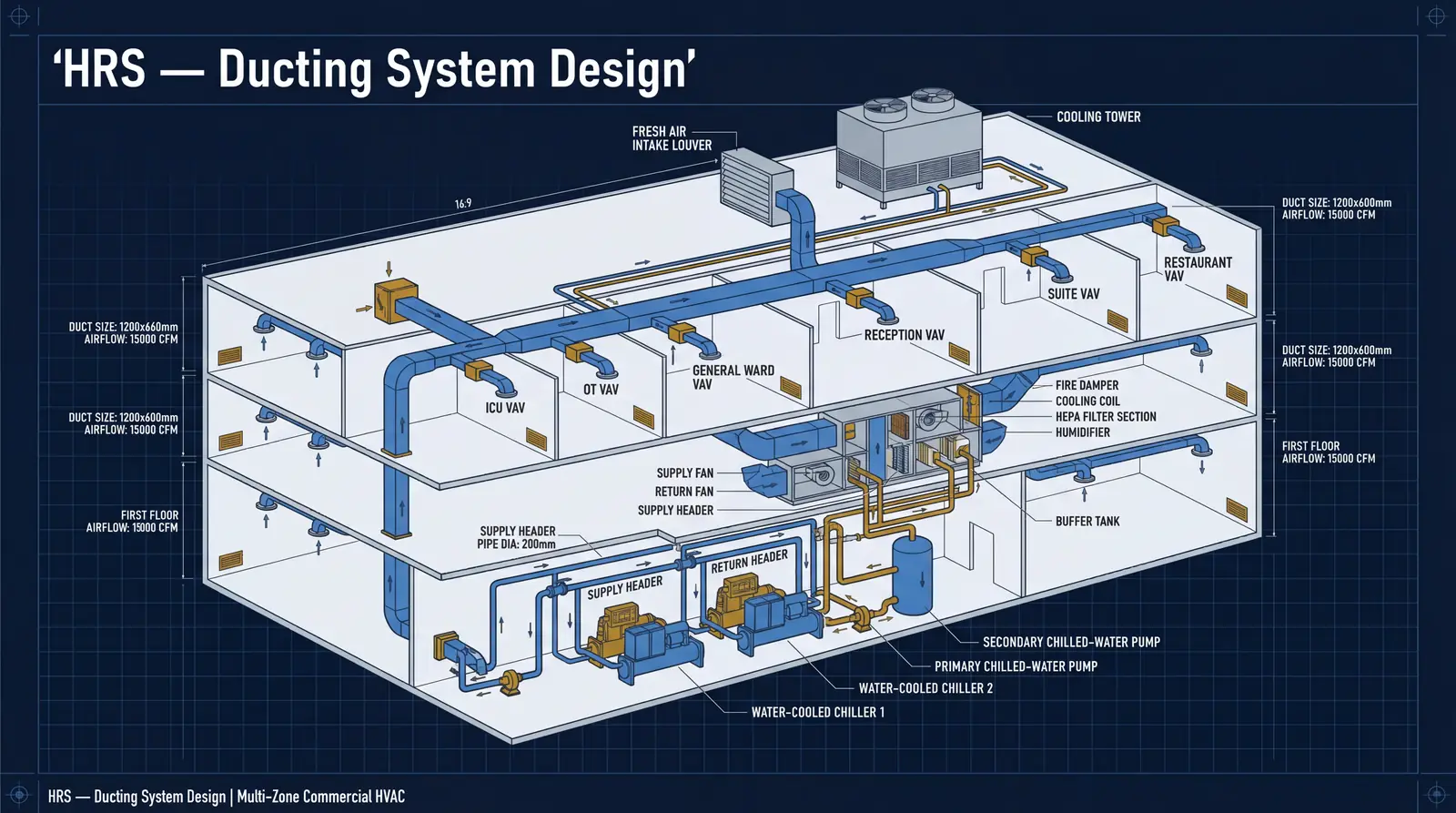
A multi-zone commercial HVAC system is not a scaled-up split AC. It is an engineered assembly of interconnected sub-systems that must work in concert to maintain independent temperature, humidity, and air-quality conditions across diverse spaces - simultaneously. Understanding this architecture is essential for facilities managers, building developers, and anyone specifying or maintaining commercial HVAC.
The Central Plant: Where Cooling Originates
Cooling Tower
At the top of the system sits the cooling tower. It rejects heat from the condenser water loop to ambient air through evaporative cooling. In Kerala's climate, with wet-bulb temperatures of 27–29°C during peak summer and monsoon, the cooling tower must be correctly sized to maintain adequate condenser water temperatures - typically 32°C supply, 37°C return.
A fouled cooling tower (scale, biofilm, or fill degradation) raises condenser water temperature, which directly reduces chiller efficiency. In humid coastal locations like Kochi, cooling tower maintenance - drift eliminators, basin cleaning, water treatment, fill inspection - is a quarterly requirement, not an annual one.
Water-Cooled Chillers
The central plant uses water-cooled screw or centrifugal chillers to produce chilled water at 6–12°C for distribution to AHUs. Water-cooled chillers achieve COP values of 5.0–6.5, significantly higher than air-cooled equivalents (COP 2.8–3.8) - the efficiency gain that justifies the additional complexity of a cooling tower circuit.
For critical facilities, two chillers in N+1 configuration is standard. The sequencing logic - which chiller starts, when the standby unit activates, and how part-load is shared - is managed by the Building Management System (BMS).
Buffer Tank
Between the chiller plant and the distribution network, a buffer tank (or thermal buffer vessel) is installed. This serves two purposes:
- Hydraulic decoupling - it separates the primary chiller loop from the secondary distribution loop, allowing each to operate at independent flow rates. This prevents hunting and instability in the control systems.
- Thermal mass - it provides a buffer of stored chilled water capacity that prevents rapid chiller cycling during fluctuating load conditions. A correctly sized buffer tank means the chiller does not start-stop repeatedly during partial-load operation - extending compressor life significantly.
Chilled Water Pumps
Two pump sets are typically deployed: primary pumps (dedicated to the chiller loop, constant speed) and secondary pumps (variable speed, driving chilled water through the distribution network). The secondary pumps are inverter-driven and respond to differential pressure sensors in the distribution network - slowing down as zone demand drops, reducing pump energy consumption by up to 60% at partial load.
The Distribution Network
Supply and Return Duct Mains
From the Air Handling Units, insulated sheet metal ducts carry conditioned air to each zone. The supply duct is the positive-pressure side - conditioned air is pushed outward. The return duct draws room air back to the AHU for reconditioning. The difference in flow between supply and return (the outdoor air fraction) provides the fresh air component required by ventilation standards.
Duct sizing follows velocity pressure calculations. Oversized ducts are quiet but expensive. Undersized ducts generate noise and pressure loss. The design target is typically 5–8 m/s in main duct sections, reducing to 3–5 m/s at branch points and 1.5–2.5 m/s at diffusers.
Air Handling Unit (AHU)
The AHU is the point where chilled water meets air. Inside the AHU casing:
- Pre-filter - coarse particulate removal (G4 or M5 grade)
- Cooling coil - chilled water (6°C supply) cools and dehumidifies supply air
- Fine filter - F7 or F9 grade for commercial applications; HEPA (H13/H14) for critical areas
- Supply fan - variable speed, sized for zone airflow requirements
- Return fan - balances return airflow; maintains zone pressure relationships
- Humidifier - for zones requiring tight RH control (data centres, precision labs, OTs)
Each AHU serves a defined pressure zone. The supply and return fans are matched to maintain the required zone pressure differential relative to adjacent spaces.
HEPA Filtration Section
In healthcare facilities, the AHU includes a dedicated HEPA filter section - terminal filter boxes with H13 or H14 cartridges in gasketed, leak-tested frames. HEPA filtration captures 99.95–99.995% of particles ≥0.3 µm, including airborne bacteria and virus-carrying droplets.
The critical detail: a bypassing HEPA filter (even 1% bypass at the frame gasket) renders the filtration functionally useless for infection control. Terminal HEPA boxes must be installed with tested gasketed seals and verified after installation with particle count measurements.
Zone-Level Control
VAV Boxes (Variable Air Volume)
In zones where thermal load varies - conference rooms, open-plan offices, retail areas - VAV boxes modulate airflow to match actual demand. Each VAV box has an actuator, a calibrated flow sensor, and a zone thermostat input. The BMS coordinates VAV positions across the network, adjusting secondary pump speed and AHU fan speed in response.
VAV systems achieve significant energy savings in part-load conditions - fans and pumps running at reduced speed consume energy proportional to the cube of speed (fan laws). A fan at 70% speed consumes only ~34% of its full-speed power.
Critical areas use CAV (Constant Air Volume) terminals, not VAV. Operating theatres, ICUs, and isolation rooms must maintain fixed airflow regardless of temperature demand - to preserve pressure relationships and infection-control ventilation rates.
Fire Dampers
At every point where a duct penetrates a fire compartment wall, a fire damper is installed. Spring-loaded blades are held open by a fusible link rated at 70°C. In a fire event, the fusible link melts, the spring closes the blades, and the duct is sealed - preventing the HVAC system from acting as a fire propagation pathway.
Fire dampers must be tested at commissioning and annually thereafter. A seized or blocked fire damper does not fail safely. This is a life-safety item, not a maintenance convenience.
Zone Examples: Different Requirements, Same System
A well-designed multi-zone system serves radically different environments from the same central plant:
| Zone | Temperature | RH | Pressure | Terminal type |
|---|---|---|---|---|
| Restaurant | 22–24°C | 50–60% | Neutral | VAV with fan-coil |
| Hotel Suite | 20–26°C (guest-set) | 45–55% | Neutral | FCU with individual control |
| Reception | 22–24°C | 50–60% | Slightly positive | VAV |
| General Ward | 22–26°C | 40–60% | Slightly positive | CAV |
| ICU | 22–24°C | 40–60% | Positive (+15 Pa) | CAV + HEPA |
| Operating Theatre | 18–22°C | 40–60% | Positive (+20 Pa) | CAV + HEPA |
The diversity of these requirements - all served from a shared central plant - is what makes multi-zone design complex and why generic estimates are not substitutes for proper engineering.
Why This Matters for AMC
A multi-zone ducted system has many more failure points than a split AC installation:
- Cooling tower biological contamination (Legionella risk)
- Chiller sequencing failures (single-point reliance on standby)
- Buffer tank stratification (poor mixing, reduced effective capacity)
- Variable-speed pump failures (full system flow loss)
- VAV box actuator seizure (zone heating or over-cooling)
- HEPA filter bypass (infection-control failure in healthcare)
- Fire damper seizure (life-safety risk)
A structured Annual Maintenance Contract for a multi-zone system is not optional - it is the mechanism by which these failure modes are caught before they become clinical, financial, or safety incidents.
HRS provides HVAC maintenance contracts for commercial and healthcare multi-zone systems across Kerala, including full BMS integration, pressure testing, filter integrity verification, and fire damper compliance testing.
To discuss an AMC for a multi-zone commercial HVAC system, contact ho@hitechrefrigeration.services.
Why This Matters To HRS
How HRS applies this in real air-distribution work
Grilles, diffusers, humidity control, and ducting choices only pay off when they are designed around the space instead of added as afterthoughts. HRS uses that layer to improve airflow quality, maintenance access, and the final visual finish.
Related Service
Custom Ducting & Ventilation SystemsKeep Exploring
Continue from this guide into the matching HRS service page or a relevant Kerala service area.
Related Services
Need expert HVAC help?
Contact our team for professional installation, maintenance, or a custom consultation.