30 August 2025
Hospital HVAC Design: Why Healthcare Air Conditioning Is an Engineering Discipline
A blueprint-level look at the components of a hospital HVAC system - cooling towers, chillers, AHUs, VAV boxes, HEPA filtration, and infection-control ventilation - and why getting any element wrong has clinical consequences.
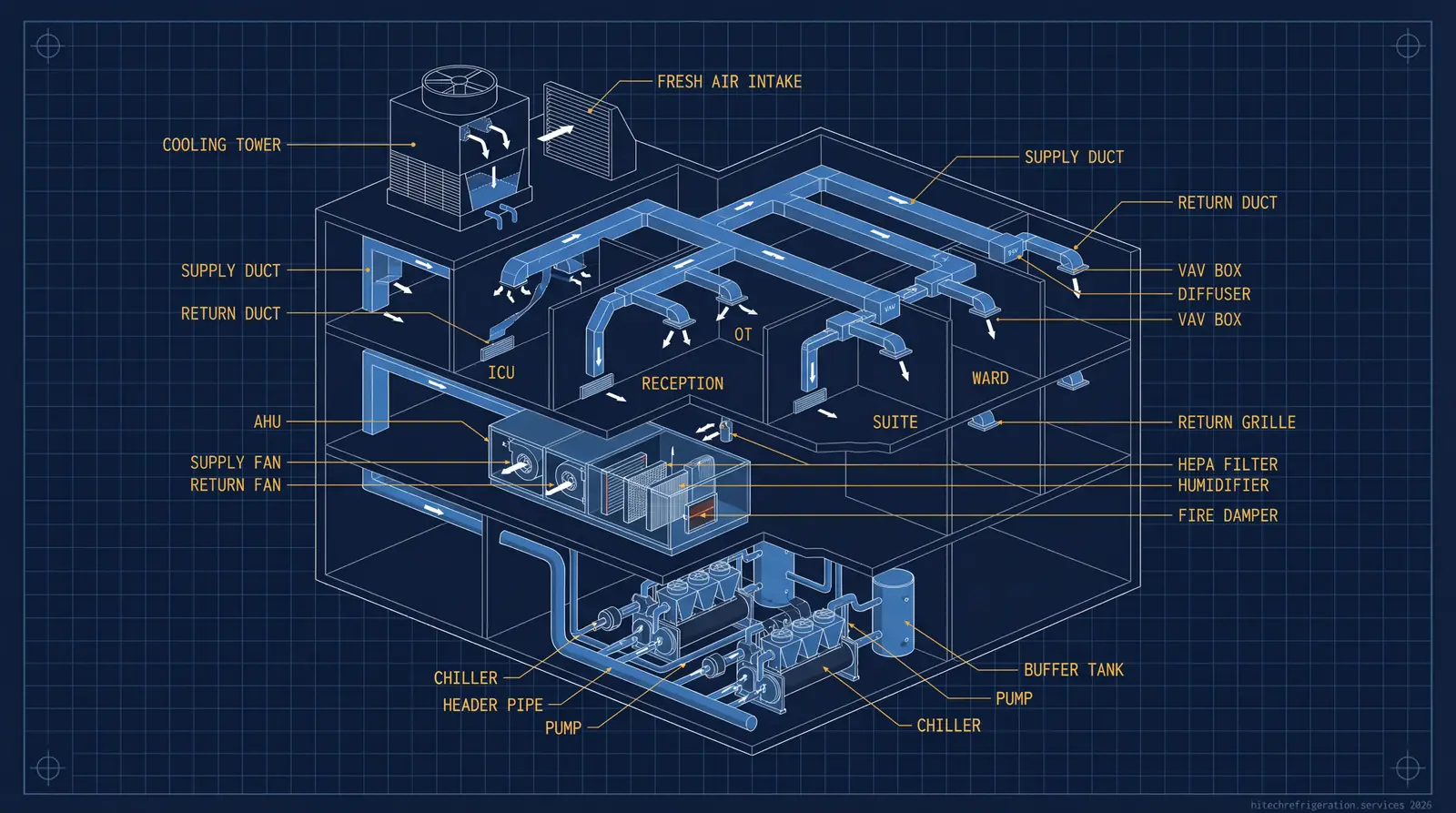
Hospital HVAC is not commercial air conditioning. It is a clinical system. The air distribution design inside a hospital directly affects infection rates, surgical outcomes, pharmaceutical storage integrity, and patient recovery. Getting it right requires understanding the engineering - not just the equipment.
The Core System Architecture
A hospital HVAC system typically comprises several interconnected subsystems working in concert. Here is each one.
Cooling Tower
The cooling tower sits at the top of the system hierarchy. In a chilled-water plant, the cooling tower rejects heat from the condenser water loop to ambient air through evaporative cooling. A properly sized and maintained cooling tower is essential for chiller efficiency - a fouled cooling tower increases chiller energy consumption by 10–20% and accelerates condenser tube scaling.
For hospitals in Kerala's humid climate, cooling towers must handle high wet-bulb temperatures (typically 27–29°C). This limits the approach temperature achievable, which limits how cold the condenser water can be, which directly affects chiller COP.
Chiller Plant
Hospital chilled-water plants use centrifugal or screw chillers to produce chilled water at 6–12°C, which is then distributed to air handling units throughout the facility. Two chillers in N+1 redundancy configuration is standard for hospitals - a single-chiller plant represents an unacceptable single point of failure for critical environments.
Chiller sequencing - the logic that determines when to start or stop the standby chiller - should be optimised based on actual cooling load, not just outdoor temperature. Modern hospital chiller plants use a BMS with load-based sequencing to minimise energy consumption while maintaining redundancy.
Air Handling Units (AHUs)
Air handling units are the distributed cooling points of the hospital. Each AHU serves a defined zone and comprises:
- Cooling coil (chilled water)
- Supply and return fans
- Filters (pre-filter + fine filter, HEPA for critical areas)
- Heating coil (in climates requiring it - less relevant in Kerala)
- Humidifier (for critical areas requiring tight RH control)
AHU zoning in a hospital is not merely about temperature control - it defines the pressure relationships between spaces. Infection control requires specific pressure cascades.
VAV Boxes (Variable Air Volume)
VAV boxes modulate airflow to individual rooms or zones within each AHU's territory. They allow the AHU to vary its total airflow based on actual demand, significantly reducing fan energy consumption. Each VAV box has an actuator and a flow sensor, controlled by the BMS.
Critical hospital areas (operating theatres, ICUs, isolation rooms) typically use constant-volume (CAV) terminals rather than VAV - because airflow in these areas must be maintained regardless of temperature demand, for infection control purposes.
HEPA Filtration
High-Efficiency Particulate Air (HEPA) filtration - rated at H13 or H14 under EN 1822 - captures 99.95–99.995% of particles ≥0.3 μm. This includes airborne bacteria and most viruses when carried on respiratory droplets.
HEPA filters are mandatory in:
- Operating theatres
- Intensive care units
- Isolation rooms (negative pressure)
- Bone marrow transplant units
- Pharmaceutical clean rooms within hospital pharmacies
HEPA filters must be installed in terminal filter boxes with leak-tested gasketed frames. A bypassing HEPA filter - even at 1% bypass - renders the filtration functionally useless for infection control.
Pressure Relationships and Infection Control
This is the most clinically critical aspect of hospital HVAC design, and the most frequently misunderstood.
Positive pressure: Supply air flow exceeds exhaust, creating net positive pressure relative to adjacent spaces. Contaminants from adjacent spaces cannot enter. Used for: operating theatres, ICUs, bone marrow transplant units, sterile pharmaceutical areas.
Negative pressure: Exhaust exceeds supply, creating net negative pressure. Contaminated air from within the room cannot escape to adjacent spaces. Used for: tuberculosis isolation rooms, infectious disease wards, COVID isolation.
Pressure cascade: A hospital zone has multiple pressure levels in sequence. The operating theatre is at +20 Pa, the scrub area at +15 Pa, the corridor at +10 Pa, and the external corridor at atmospheric. Air flows outward at every step - contaminants cannot travel inward to the clean zone.
Maintaining these pressure relationships requires:
- Sealed room construction (gaps around doors, penetrations, and service entries sealed)
- Balanced air systems (supply and exhaust flows confirmed after installation)
- Commissioning with pressure measurement at every room
- Regular re-commissioning (pressure differentials drift with building settlement, door wear, and filter loading)
Fire Dampers and Smoke Control
Hospital HVAC ducts penetrate fire compartment walls throughout the building. Fire dampers - spring-loaded blades held open by a fusible link - close automatically at 70°C to prevent duct systems from acting as fire spread pathways. They must be tested annually.
Smoke control dampers, in smoke-ventilation systems, are motorised and BMS-controlled. They open specific exhaust paths to clear smoke from escape routes in a fire event. Their correct operation is life-safety critical and subject to regulatory compliance testing.
Common Failures and Their Clinical Consequences
| Failure | Clinical consequence |
|---|---|
| HEPA filter bypass | Surgical site infections, HAI outbreaks |
| Pressure cascade reversal | Cross-contamination between wards |
| Cooling tower Legionella | Legionnaires' disease risk |
| AHU filter overloading | Reduced airchange rates, IAQ deterioration |
| VAV box failure | Zone temperature loss, staff and patient discomfort |
| Condensate drain blockage | Mould growth in AHU and ductwork |
HRS and Healthcare HVAC
HRS has installed and maintained HVAC systems for hospitals across Kerala including Kinder Hospital, MOSC Medical Mission Hospital, GMC Thrissur, and diagnostic facilities including Metro Scans and Laboratory. Our engineers understand the critical environment requirements that distinguish healthcare HVAC from standard commercial installations.
For healthcare facilities, we offer:
- HVAC design review and commissioning support
- Quarterly preventive maintenance under structured AMC
- Pressure differential monitoring and re-commissioning
- HEPA filter integrity testing and replacement
- Emergency breakdown support with 4-hour response target
To discuss a healthcare HVAC AMC or new installation, contact ho@hitechrefrigeration.services.
Why This Matters To HRS
How HRS handles the commercial side of this topic
For offices, banks, hospitals, and similar sites, HRS works as a commercial HVAC contractor rather than a retail AC reseller. The real value is in matching system type, air distribution, serviceability, and operating expectations to the business environment.
Related Service
Commercial & Corporate HVAC SystemsKeep Exploring
Continue from this guide into the matching HRS service page or a relevant Kerala service area.
Related Services
Need expert HVAC help?
Contact our team for professional installation, maintenance, or a custom consultation.