6 September 2025
Cold Chain Logistics: How Temperature-Controlled Goods Stay Cold from Warehouse to Shelf
A three-zone breakdown of cold chain logistics - cold storage warehouse, refrigerated transport (reefer trucks), and retail cold rooms - and what keeps the temperature-sensitive supply chain intact across all three.
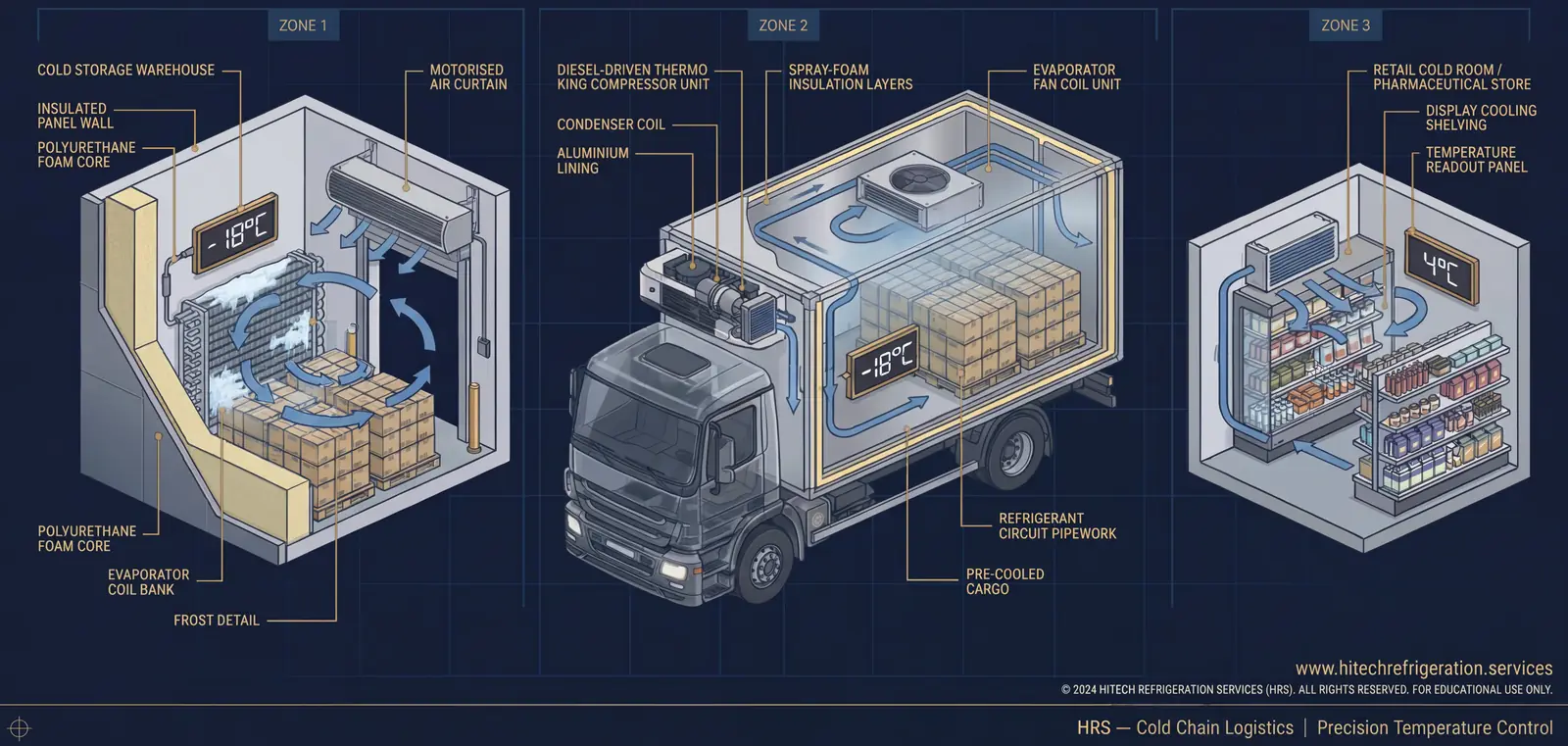
Cold chain logistics is the unbroken sequence of temperature-controlled storage and transport that keeps perishable goods safe from point of production to point of sale. Break any link in this chain - a warehouse compressor failure, a poorly insulated truck body, an undersized retail cold room - and the consequences range from product loss to public health incidents.
Here is a zone-by-zone breakdown of how a cold chain is engineered and where it most commonly fails.
Zone 1: Cold Storage Warehouse (-18°C)
The Core Requirement
Cold storage warehouses for frozen goods maintain temperatures at or below -18°C. This is not an arbitrary figure - at -18°C, the enzymatic and microbial activity that causes food spoilage is effectively halted. Ice cream, frozen meat, seafood, and pharmaceutical products requiring frozen storage all depend on this threshold being consistently maintained - not just on average, but continuously.
A warehouse that cycles between -15°C and -22°C is not the same as one that holds steadily at -18°C, even if the average is correct. Temperature fluctuation causes ice crystal formation in frozen foods, degrading texture and quality, and can allow brief periods of microbial activity during warm excursions.
The Refrigeration Plant
A typical cold storage plant for -18°C operation uses:
- Screw or reciprocating compressors - capable of operating at the high compression ratios required for sub-zero evaporating temperatures
- Ammonia (R-717) or R-404A refrigerant - ammonia is preferred for large industrial warehouses due to superior thermodynamic efficiency; R-404A (transitioning to R-448A/R-449A) for smaller facilities
- Evaporators - ceiling-mounted coil units with defrost cycles (hot gas or electric) to prevent ice accumulation on coil fins
- Air curtains and dock levellers - at loading bay doors, to limit warm air ingress during goods receiving
Insulation
The warehouse envelope is the passive component of cold chain: spray polyurethane foam (SPF) panels or PIR (polyisocyanurate) insulated panels, typically 150–200 mm thick for -18°C storage. Thermal bridging - metal structural elements that bypass the insulation layer - is the most common source of condensation and heat gain in cold stores.
Doors are insulated sliders or rapid-roll PVC curtain doors. Every second a warehouse door is open during a Kerala summer (ambient 35°C, 80% RH) introduces a significant heat and moisture load that the refrigeration plant must remove.
What Goes Wrong
The most common warehouse cold chain failures:
- Compressor overload - undersized plant or high ambient temperatures in the machine room causing high condensing pressure
- Defrost control failure - inadequate or excessive defrost cycles causing coil icing or product temperature excursion during defrost
- Door seal degradation - worn or poorly fitted door seals allowing continuous warm air infiltration
- Power outage without standby - generator backup is not optional for cold storage; a 4-hour power failure at -18°C can cause irreversible product loss
Zone 2: Refrigerated Transport (Reefer Truck)
The Moving Challenge
A refrigerated truck - a reefer - faces a fundamentally harder problem than a static cold store. It operates in variable ambient conditions, with a constant vibration load, a varying cargo mass, frequent door opening at delivery stops, and a diesel-driven refrigeration unit whose performance is linked to engine speed and fuel quality.
The Reefer Unit
Most refrigerated trucks in India use diesel-driven rooftop or front-mounted reefer units from manufacturers including Thermo King and Carrier Transicold. The unit comprises:
- Engine-driven compressor - separate diesel engine, independent of the truck's main engine
- Air-cooled condenser - mounted externally, facing forward for ram-air cooling at road speed
- Evaporator - ceiling-mounted inside the cargo body, with a blower fan for air circulation
- Return air sensor - controls unit operation based on return air temperature, not supply air temperature (important distinction for defrost and setpoint control)
The Insulated Body
The truck body is the thermal barrier. For -18°C operation, bodies use spray polyurethane foam (minimum 75–100 mm) with fibreglass or stainless steel inner liners. Body integrity - including door seals, body joints, floor panels, and the roof-unit mounting flange - determines how hard the refrigeration unit has to work.
An ATP (Agreement on the Transport of Perishables) certification, required for cross-border refrigerated transport in many countries, measures the body's thermal performance (K-value) and the unit's cooling capacity against a standardised test. In India, FSSAI regulations for cold chain vehicles are progressively requiring equivalent standards.
Kerala-Specific Considerations
Kerala's humid climate creates specific reefer challenges:
- High ambient wet-bulb temperature - limits how cold the condenser can reject heat, reducing unit capacity
- Coastal salt air - accelerates corrosion on condenser coil fins and unit chassis; requires more frequent coil washing and anti-corrosion treatment
- Stop-start urban delivery routes - frequent door opening in humid conditions introduces massive moisture loads; defrost cycles must be tuned for Kerala conditions, not factory defaults set for European climates
What Goes Wrong
- Reefer unit fuel starvation - blocked fuel filters, air in the fuel line (common with low-quality diesel), or kinked fuel lines cause unit shutdown mid-transit
- Evaporator icing - inadequate defrost frequency, or defrost sensor failure, causes the evaporator coil to ice over, blocking airflow and losing cooling capacity
- Body seal failure - door gaskets compress and lose their seal over time; a failed door seal on a reefer doing multiple delivery stops can raise cargo temperature by 5–8°C over a 6-hour route
- Temperature recorder gaps - data loggers must record continuously; gaps in the record (unit restart, data logger battery failure) create compliance and traceability problems for FSSAI and customer audits
Zone 3: Retail Cold Room (+4°C)
Purpose and Setpoint
Retail cold rooms maintain chilled (not frozen) storage at +2 to +6°C - the range that inhibits bacterial growth in fresh products (meat, dairy, produce, beverages) without freezing them. Supermarkets, restaurants, hotel kitchens, and hospitals all depend on reliable cold room operation.
Refrigeration at Retail Scale
A retail cold room typically uses a condensing unit (compressor + air-cooled condenser, packaged together or remote) connected to one or more evaporator coil units inside the cold room. Refrigerants are transitioning from R-404A to R-448A, R-449A, or R-290 (propane) for smaller units.
The condensing unit is installed outside the cold room - either on the rooftop, in a plant room, or on an external wall. Running refrigerant lines through walls introduces penetrations that must be properly sealed and insulated to prevent moisture ingress and thermal bridging.
Display Refrigeration
Open-deck display cases (the refrigerated shelves you see in supermarkets) are the highest-maintenance element of retail cold chain. They operate without doors, relying on a curtain of cold air to maintain temperature. This design maximises product visibility and customer access - at the cost of significantly higher energy consumption and a constant battle against ambient warm air intrusion.
Open-deck cases are particularly challenging in Kerala's humid climate. The moisture in ambient air condenses heavily on open cases, requiring aggressive anti-fog glass heaters and frequent coil defrost cycles to maintain performance.
What Goes Wrong
- Condenser coil fouling - grease and dust in kitchen environments coat condenser coil fins rapidly; a fouled coil on a kitchen cold room can raise head pressure by 30%, triggering compressor high-pressure trips
- Door gasket failure - same issue as reefer trucks, but in a retail environment with heavy door-opening traffic; gasket life in a busy kitchen cold room is 12–18 months
- Thermostat drift - mechanical thermostats in older cold rooms drift over time, causing set-point creep and undetected temperature excursions
- Defrost timer failure - electric-defrost cold rooms have a timer that initiates defrost cycles; a failed timer causes coil icing and progressive cooling loss
The Complete Cold Chain: Where Accountability Lives
The value of a cold chain is only as good as its weakest link. A product that leaves the cold store at -18°C, is transported at -15°C (due to a poorly tuned reefer), and arrives at a retail cold room running at +7°C (due to a faulty thermostat) has been subjected to two temperature excursions - both invisible in the product's appearance but both contributing to shortened shelf life and potential safety risk.
Temperature logging at each zone, with unbroken audit trails, is increasingly mandatory. FSSAI's cold chain regulations, pharmaceutical GDP requirements, and modern food retailer supplier standards all require documented proof of temperature continuity from origin to point of sale.
HRS maintains refrigeration equipment at all three zones of the cold chain: cold storage plant and evaporators, reefer unit servicing at our Kalamassery facility, and retail cold room AMC programmes across Kerala. Our engineers understand that these are not separate equipment categories - they are stages of a single unbroken system.
For cold chain refrigeration servicing, AMC, or emergency breakdown support, contact busandreefer@hitechrefrigeration.services or ho@hitechrefrigeration.services.
Why This Matters To HRS
How HRS turns this topic into practical site work
Across HVAC and refrigeration work, the useful answer is rarely just the product name. What matters is how the system is selected, installed, serviced, and supported in actual Kerala operating conditions.
Related Service
Industrial Refrigeration SystemsKeep Exploring
Continue from this guide into the matching HRS service page or a relevant Kerala service area.
Related Services
Need expert HVAC help?
Contact our team for professional installation, maintenance, or a custom consultation.