9 August 2025
Inside a Bus Air Conditioning System: Every Component Explained
An exploded-view guide to the eight major components of a transit bus air conditioning system - from the rooftop condenser unit to the engine-driven compressor - and what each one does.
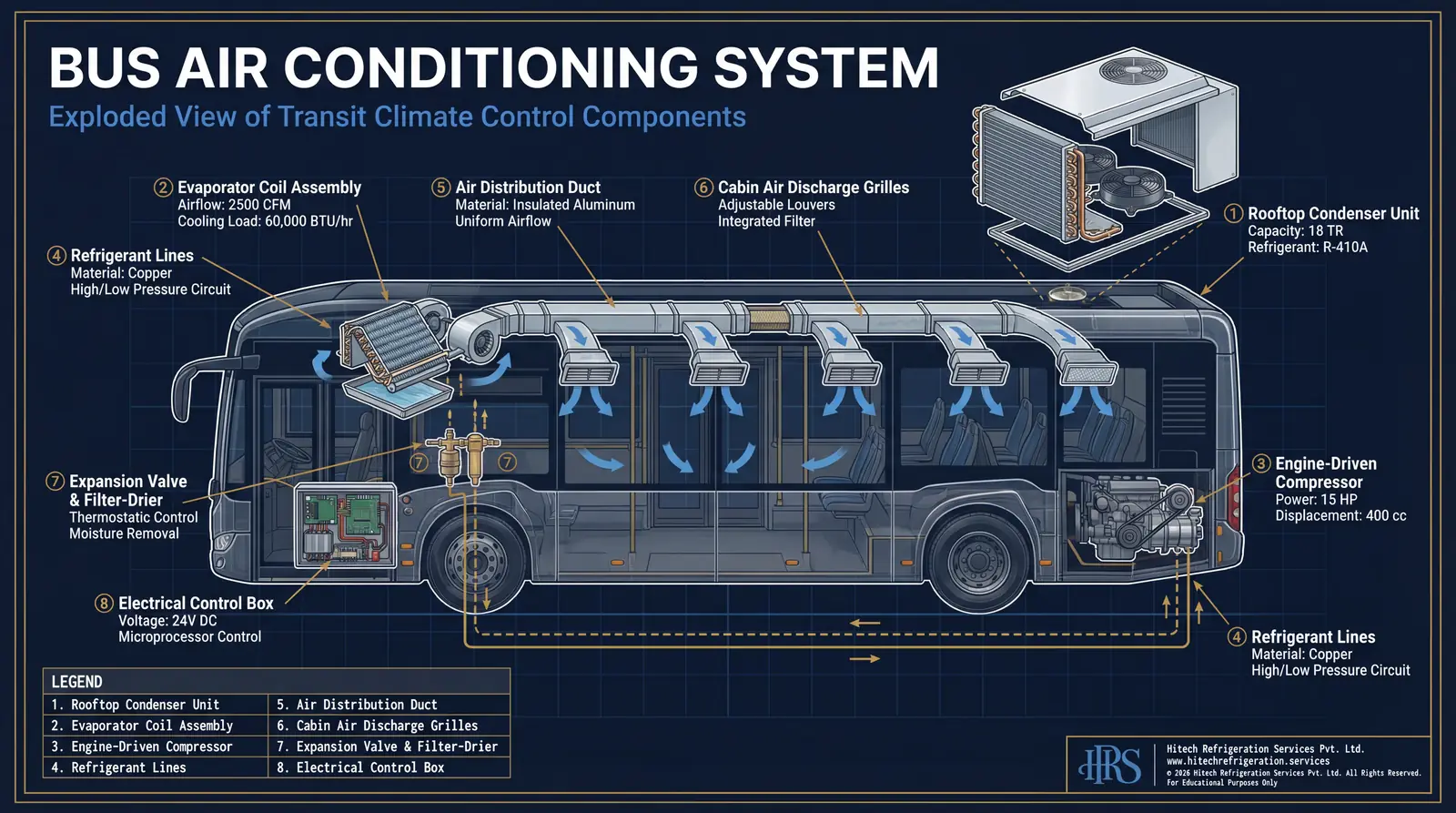
A bus air conditioning system is fundamentally different from a building HVAC system. It operates in a vibrating, mobile environment with limited installation space, variable power supply, and no fixed ambient conditions. Understanding each component helps fleet operators make better decisions about specification, maintenance, and fault diagnosis.
Here is a complete breakdown of the eight major components in a typical transit bus AC system.
1 - Rooftop Condenser Unit
Location: Roof-mounted, rear section
Capacity: 19 TR (typical for a 40-seat bus)
Refrigerant: R-410A (transitioning to R-32 and R-454B)
The condenser unit houses the condenser coil, condenser fan, and in roof-mount systems, the compressor. Hot refrigerant gas from the compressor enters the condenser coil, releases heat to ambient air driven across the coil by the condenser fan, and exits as high-pressure liquid.
Kerala-specific challenge: Roof-mounted condensers in Kerala's humid, coastal climate accumulate bio-film and salt deposits on coil fins rapidly. Monthly condenser cleaning is essential - a 20% fouled condenser coil causes a 10–15% reduction in cooling capacity.
2 - Evaporator Coil Assembly
Location: Interior ceiling duct
Airflow: 2,000 CFM (typical)
Cooling load: 60,000 BTU/hr
The evaporator coil sits inside the air distribution duct running the length of the bus interior. Refrigerant enters as low-pressure liquid, absorbs heat from cabin air passing over the coil, and exits as low-pressure vapour. This is the heat-exchange step that actually cools the air passengers feel.
The evaporator assembly includes the expansion valve, blower fans, and condensate collection tray. Condensate - water extracted from humid cabin air - must drain clear of electrical components and the bus structure. Blocked condensate drains are among the most common causes of interior water leaks in air-conditioned buses.
3 - Air Distribution Duct
Material: Insulated aluminium
Function: Uniform airflow distribution
The air distribution duct is the spine of the bus AC system. It runs the length of the vehicle, distributing conditioned air through discharge grilles positioned above the passenger rows. Uniform airflow distribution is critical - passengers in the rear seats of a bus with a poorly designed duct experience noticeably less cooling than those at the front.
Aluminium ducting is specified for bus applications because it is lightweight, non-corrosive, and tolerant of the vibration and flexing inherent in vehicle structures.
4 - Refrigerant Lines
Material: Copper (high and low pressure circuits)
Route: Throughout the vehicle chassis
Copper refrigerant lines connect the rooftop condenser, engine-driven compressor, expansion valve, and evaporator coil in a closed circuit. The high-pressure liquid line carries refrigerant from the condenser to the expansion valve. The low-pressure suction line carries refrigerant vapour from the evaporator back to the compressor.
Bus refrigerant lines must be routed and clamped to withstand road vibration over the vehicle's service life - typically 10–15 years. Loose clamps are a frequent cause of refrigerant line chafing and slow leaks.
5 - Cabin Air Discharge Grilles
Type: Adjustable louvres with integrated filter
Location: Overhead, above passenger rows
Discharge grilles distribute conditioned air into the passenger cabin. Adjustable louvres allow airflow direction to be tuned. Integrated filters - typically washable polypropylene media - capture dust and particulates from cabin air before it reaches the evaporator coil.
Filter condition directly affects system performance. A blocked filter reduces airflow, increases evaporator pressure, and can cause icing. In fleet operations, filters should be cleaned at every bus wash and inspected at weekly intervals during peak usage seasons.
6 - Expansion Valve
Type: Thermostatic
Function: Thermostatic control and moisture removal
The expansion valve is a precision metering device. It reduces high-pressure liquid refrigerant from the condenser circuit to the low pressure required for evaporation in the evaporator coil. A thermostatic expansion valve (TXV) modulates its opening based on the superheat of refrigerant leaving the evaporator - ensuring the evaporator operates at maximum efficiency without flooding the compressor.
The expansion valve assembly typically incorporates a filter-drier - a dessicant bed that removes moisture from the refrigerant circuit. Moisture in refrigerant causes ice formation at the expansion valve orifice, acid formation in the compressor oil, and copper plating on compressor surfaces. A saturated filter-drier is a common cause of progressive system performance loss in older bus AC systems.
7 - Engine-Driven Compressor
Drive: Belt-driven from engine crankshaft
Power: 15 HP (typical)
Displacement: 400 cc
Unlike building AC systems where the compressor is electrically driven, most bus AC compressors are driven directly by the bus engine via a belt and electromagnetic clutch. The clutch engages and disengages the compressor based on thermostat demand.
Engine-driven compressors create an important operational consideration: bus AC performance is tied to engine RPM. At idle, reduced engine speed reduces compressor speed and therefore cooling capacity. This is why air-conditioned buses idling at a terminus cool less effectively than buses moving at road speed.
Belt tension is a critical maintenance item. A loose belt slips under compressor load, causing belt wear, heat, and eventually belt failure. Belt tension should be checked at every scheduled preventive maintenance visit.
8 - Electrical Control Box
Voltage: 24V DC
Function: Microprocessor control of the entire AC system
The electrical control box is the brain of the bus AC system. It manages:
- Thermostat input and setpoint control
- Compressor clutch engagement and cycling
- Condenser and evaporator fan speed
- Fault detection and protection (high pressure, low pressure, high temperature)
- Diagnostic output for technician use
Modern bus AC control systems communicate fault codes through a display or LED indicator sequence. Technicians with the appropriate diagnostic tools can read fault history, operating parameters, and sensor values from the control box - dramatically reducing diagnosis time.
Common Failure Points and Prevention
| Component | Failure Mode | Prevention |
|---|---|---|
| Condenser coil | Fouling → reduced capacity | Monthly coil cleaning |
| Expansion valve | Moisture blockage | Filter-drier replacement every 2 years |
| Compressor belt | Wear → belt failure | Tension check at every PM visit |
| Condensate drain | Blockage → interior leak | Clear drain at every PM visit |
| Filter-drier | Saturation | Replace at refrigerant circuit service |
| Electrical control box | Connector corrosion | Annual connector inspection and dielectric grease application |
HRS maintains a dedicated Bus & Reefer service facility at Kalamassery with certified technicians for all major bus AC brands. Fleet AMC programmes are available for KSRTC-pattern operations and private fleet operators.
For bus AC servicing, fleet AMC, or refrigerant circuit overhaul, contact busandreefer@hitechrefrigeration.services.
Why This Matters To HRS
How HRS applies this in bus AC work
HRS runs bus air-conditioning as a specialist fleet activity, not as an extension of building AC service. That means diagnosis, parts logic, airflow understanding, and service planning are built around vehicle-duty conditions.
Related Service
Bus Air Conditioning SystemsKeep Exploring
Continue from this guide into the matching HRS service page or a relevant Kerala service area.
Related Services
Need expert HVAC help?
Contact our team for professional installation, maintenance, or a custom consultation.